Custom Short URLs vs. Generic Shorteners: Which Should You Use?
Every URL shortener produces a short link, but not every short link is custom. cut.bd/summer-sale and bit.ly/3xK9fQ2 both redirect somewhere — one was chosen on purpose, the other was handed to you. The question isn't which is "better" in the abstract; it's which one fits what you're actually sharing.
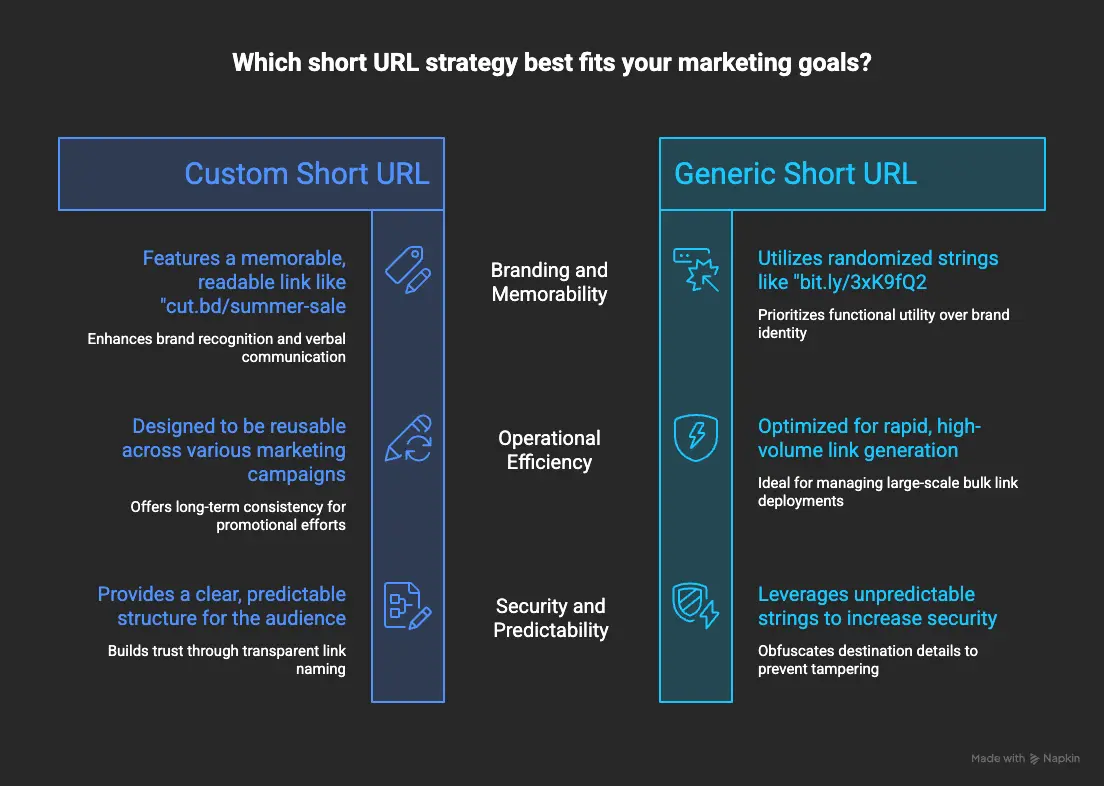
What Makes a Short URL "Custom"?
A custom short URL uses an alias you pick yourself — a real word or phrase instead of a random string. A generic one is auto-generated, usually through Base62 encoding or random string generation, and reads like x7fQ2 or 3xK9fQ2: short, but meaningless until someone clicks it.
Most shorteners, including Cut.bd, support both from the same tool — the choice is per link, not a platform lock-in.
The Case for a Custom Slug
- It's memorable without the click.
cut.bd/launchtells someone what they're about to see before they see it. A random code carries zero information. - It reads out loud. For anything spoken — a podcast ad, a conference talk, a radio spot — "cut dot bee dee slash launch" is repeatable. Nobody can recite
3xK9fQ2back to you. - It's reusable across a campaign. The same slug can show up on a poster, in an email footer, and in a bio link, reinforcing itself instead of forcing people to re-find a different code each time.
- It looks intentional. A hand-picked slug signals someone thought about the link. A random string signals it was thrown together in bulk — which is sometimes exactly what happened.
When Generic Is Actually the Right Call
Custom slugs aren't free — someone has to think of one, and it has to still be available. That cost isn't worth paying everywhere:
- One-off, low-visibility links. An internal Slack link or a single customer email doesn't need a memorable alias nobody will see twice.
- Bulk or programmatic creation. If you're generating hundreds of links through an API or a CSV import, hand-picking a slug for each one doesn't scale — auto-generation is the entire point.
- Anything where predictability is a liability. A guessable slug pattern (
promo1,promo2,promo3) makes it trivial for someone to enumerate your other links. Random codes close that gap.
This Is a Different Question Than "Branded vs. Generic Domain"
It's easy to conflate "custom slug" with "custom domain," but they're two separate levers. The slug is what comes after the domain; the domain is whose name the link carries at all. You can run a custom slug on a shared domain (bit.ly/launch) or a random code on your own domain (go.yourbrand.com/x7fQ2) — they're independent choices, and worth weighing separately rather than treating "custom" as a single on/off setting. If the domain itself is the question you're weighing, our custom domain setup guide covers that decision and the actual DNS steps.
How to Decide
Ask one question: will a person read, say, or remember this link before they click it? If yes — a poster, a business card, a verbal mention, anything repeated — pick a custom slug. If the link only ever exists as a clickable blue underline nobody looks at directly, let the shortener generate one and move on.
Where Cut.bd Fits
Every link on Cut.bd lets you set a custom alias at creation time, or skip it and let the system generate one — same tool, no separate "vanity URL" upsell. If you're still deciding whether a shortener is the right move at all, our guide to how URL shorteners work covers the fundamentals first.
Found this useful? Share it.
Try Cut.bd's link shortener — free, no account required.
Shorten a link