How Much Do Branded Links Actually Lift CTR? A Worked Example
You'll find plenty of marketing pages citing a specific case-study percentage for how much a branded domain lifts click-through rate — a suspiciously round, suspiciously large number, usually with no methodology attached. This isn't that. Nothing below is a real customer result; it's a clearly-labeled worked example showing how the mechanism plays out, plus the actual method for measuring your own real number instead of borrowing someone else's.
The Mechanism, Recapped
Branded domains outperform generic ones on CTR for three structural reasons: the domain is the only trust signal available before a click, a recognized brand name borrows trust it already built elsewhere, and a domain unique to one business carries only that business's reputation instead of a shared shortener domain's aggregate one. Those mechanisms are real and well-understood. What isn't universal is the size of the effect — that depends on the audience, the channel, and how unfamiliar the generic domain looks in context, which is exactly why one borrowed percentage can't responsibly stand in for your own result.
A Worked, Hypothetical Example
Here's how the math would work if you wanted to model this before running a real test — with clearly invented numbers, not measured ones:
Say a campaign sends 10,000 people to a link, split evenly between a generic shortener domain and a branded one. If the generic link converts at a 2% click-through rate — a made-up baseline for this example — and the branded link's improved trust signal is worth a 20% relative lift for illustration only, that would work out to roughly 2.4% for the branded link: 120 clicks instead of 100 out of the 5,000 sent through it, a 20-click difference. Change either assumption — the baseline rate, the size of the lift — and the result changes proportionally. That sensitivity is the actual point: a single headline percentage from someone else's campaign tells you almost nothing about what the same mechanism would do with your baseline rate and your audience.
How to Measure the Real Number for Your Own Audience
This is the same method covered for landing page A/B tests, applied to the domain instead of the page:
- Two short links to the same destination — one on a generic domain, one on your branded domain, both otherwise identical.
- A genuinely random split of one audience, in the same channel and time window — not different platforms, not different weeks, for the same reasons that make any A/B split honest or not.
- A large enough sample before drawing a conclusion — hundreds of clicks per arm at minimum, the same threshold that applies to any click-through comparison.
- Compare click-through rate, not raw clicks — the percentage of people who saw the link and clicked it, which requires knowing how many people were actually exposed to each version, not just counting clicks in isolation.
What a Real Test Would Look Like
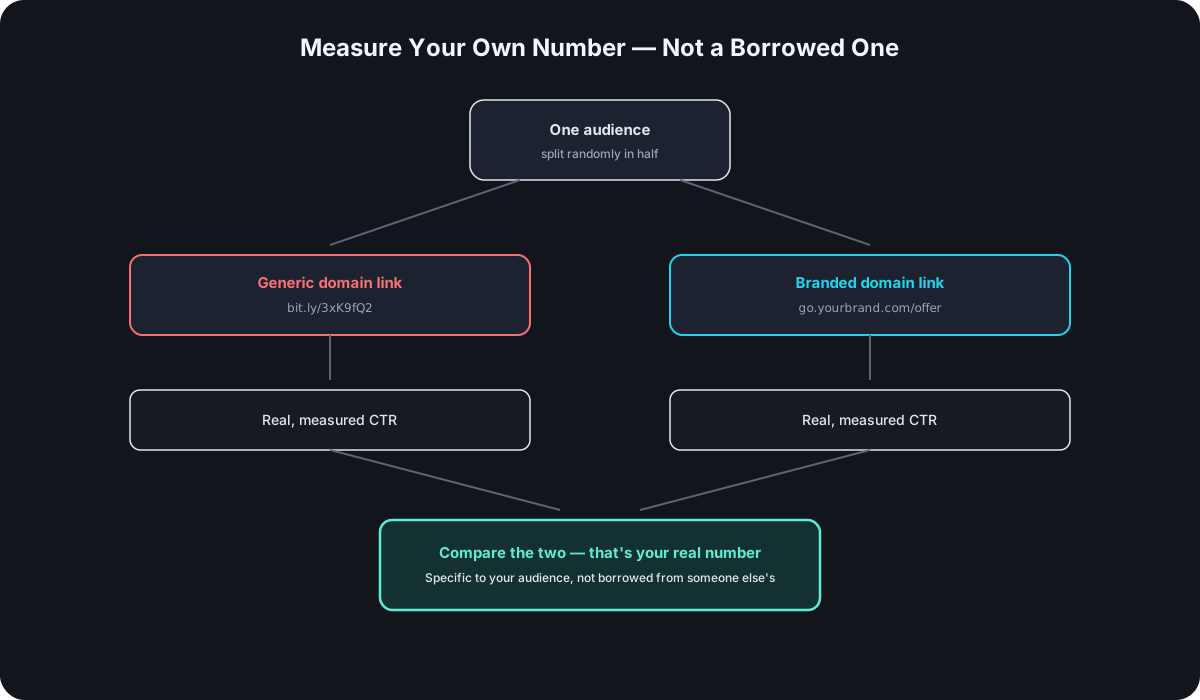
Concretely: pick one campaign, one audience, one time window. Split the audience randomly in half. Send half a link on a generic domain and half the identical link on your branded domain, both tagged with matching UTM parameters aside from a distinguishing utm_content value. Let it run to a real sample size, then compare the two click-through rates directly. Whatever number comes out the other end is a real, defensible figure for your own audience — not a borrowed one that may not transfer at all.
Setting Realistic Expectations
The size of the effect isn't constant across contexts, which is worth expecting going in rather than discovering after a disappointing test: cold audiences — ads, cold outreach, print — lean on the domain signal more heavily than warm audiences who already trust the sender regardless of what domain the link sits on. A test run on an email to existing subscribers and a test run on a cold ad campaign can legitimately produce different-sized lifts from the same underlying mechanism, because the audience's starting trust level differs going in.
Frequently Asked Questions
Why not just cite an industry-average CTR lift for branded links? Because "industry average" figures for this specific comparison are rarely published with real methodology attached, and even a genuine one wouldn't necessarily transfer to a different audience, baseline rate, or channel — the honest answer is that your own measured number is the only one that actually applies to your situation.
Is it worth running this test if I'm already convinced branded domains help? Yes — knowing that something helps and knowing how much are different questions with different practical uses. The size of the effect is what tells you whether the setup effort was worth it for this specific use case.
How long does a test like this need to run? Until the sample size threshold is reached in full-week increments, the same guidance as any A/B test — typically two to four weeks for small-to-medium audiences, not two to four days.
What if my test shows little to no difference? That's a real, useful result — it likely means your audience already trusts the sender regardless of domain, which is common for warm, existing-relationship channels. It doesn't mean the mechanism is false, just that this particular context doesn't lean on it heavily.
Should I publish my own results once I have them? If the sample size was genuinely adequate and the split was honestly random, yes — a real, specific number from your own measured test is exactly the kind of evidence a borrowed industry statistic can't provide, and it's worth more to your own future decisions than any external figure would be.
Where Cut.bd Fits
Running this test is the same two-link setup covered for landing page A/B tests — custom aliases on both a generic and a branded domain, the built-in UTM builder for consistent tagging, and per-link click analytics to compare the two arms directly once the test has run.
Found this useful? Share it.
Try Cut.bd's link shortener — free, no account required.
Shorten a link