Self-Hosted URL Shorteners: Open Source Options
A self-hosted URL shortener is software you run on your own infrastructure instead of a service someone else operates. The redirect logic is the easy part — building a minimal one yourself is a weekend project. The real question this post answers isn't "which open source option is best," it's whether self-hosting is the right call at all before you pick one.
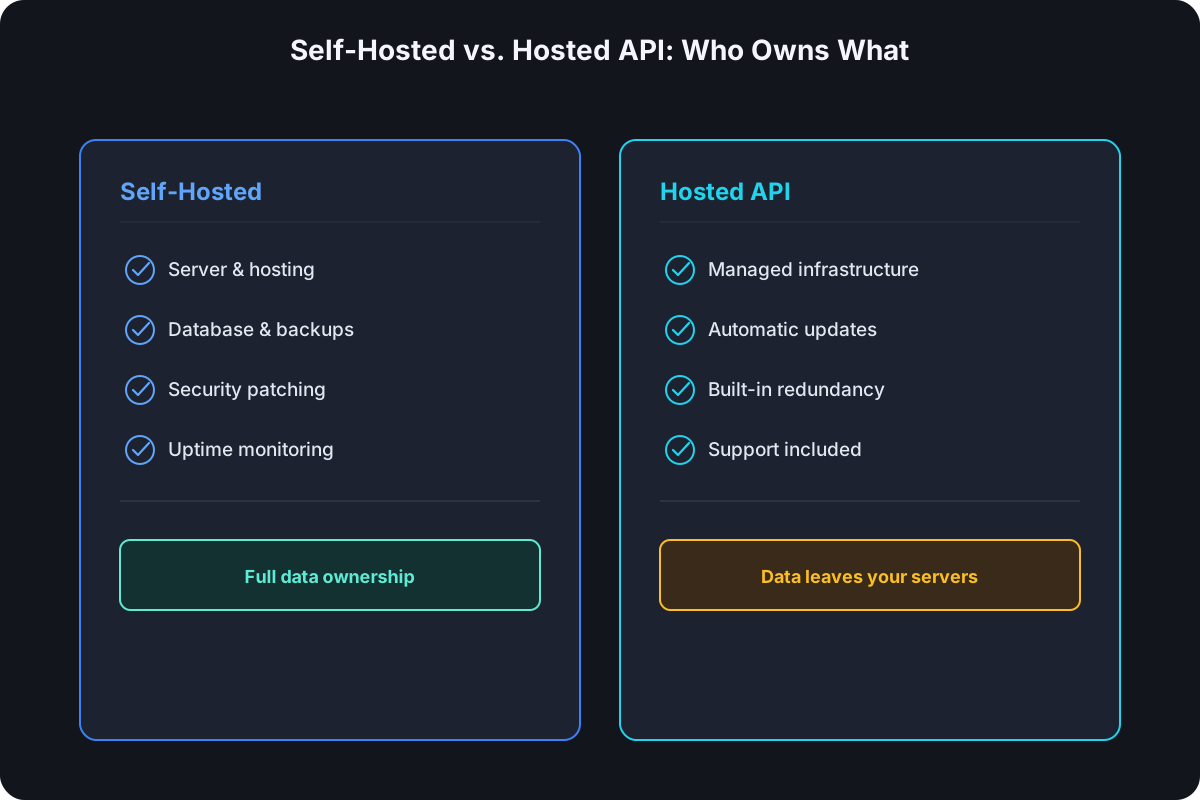
Why Self-Host at All
The legitimate reasons come down to a short list:
- Data sovereignty. If click data — IPs, device info, referrers — can't leave your own infrastructure for compliance or contractual reasons, self-hosting isn't a preference, it's a requirement.
- Full customization. Modifying the actual source is sometimes the only way to get behavior no hosted API exposes, especially around custom business logic tied to a redirect.
- No vendor lock-in. Your links, your database, your uptime — nobody else's pricing changes or shutdown decision affects you.
- Cost, at genuinely extreme volume. This one is real but frequently overestimated — see below before assuming self-hosting is cheaper.
If none of these apply to your situation, the case for self-hosting mostly evaporates, and a hosted API is very likely the faster, cheaper path to the same result.
What You're Actually Signing Up For
"Free and open source" describes the software license, not the total cost. Running any of the options below in production means you now own:
- Server hosting — provisioning, and paying for, compute that stays available.
- Database setup and backups — links and click data live in a database you're now responsible for backing up and restoring correctly.
- Security patching — the software, its dependencies, and the underlying OS all need updates applied by someone, on a schedule, indefinitely.
- Uptime monitoring — a hosted API's downtime is their incident; a self-hosted shortener's downtime is yours to notice and fix.
- SSL and DNS for custom domains — certificate renewal and DNS configuration, per domain, forever.
None of this is exotic sysadmin work, but it's ongoing, not a one-time setup cost — which is exactly the trade a hosted API is priced to remove.
The Open Source Options
- YOURLS — the oldest and most widely deployed option, PHP-based, built around a plugin architecture that extends a fairly minimal core. Its age is an advantage: broad community documentation and a large plugin ecosystem covering most gaps in the base install.
- Shlink — a more modern, API-first PHP project, designed around REST endpoints from the start rather than a UI with an API bolted on. Ships with straightforward Docker deployment, and pairs with a separate web client if you want a dashboard rather than API-only access.
- Kutt — built on Node.js/TypeScript, with a clean web UI included out of the box. A natural fit if the rest of your stack is already JavaScript, since you're not introducing a second language just to run the shortener.
- Polr — a lighter-weight PHP option aimed at simpler needs than YOURLS or Shlink — fewer moving parts, a smaller feature set, less to configure and maintain.
All four are real, actively-used projects rather than abandoned experiments, but "actively used" doesn't mean "zero maintenance" — every one of them still needs the operational work described above.
What Self-Hosted Options Typically Lack Out of the Box
Compared to a hosted API, the gap is usually in the parts that aren't the core redirect logic:
- Multi-region redundancy — a single self-hosted instance is a single point of failure unless you deliberately architect around that, which is significant additional work.
- Advanced analytics — most self-hosted options ship with basic click counts; device, location, and referrer breakdowns often require plugins or custom development.
- Automatic security updates — hosted APIs patch themselves; self-hosted software patches when you apply the update.
- Support and SLAs — community forums and GitHub issues instead of a support contract with a response-time guarantee.
How to Decide
Three honest questions settle it in most cases:
- Do you have an actual compliance or data-sovereignty requirement, not just a general preference for owning infrastructure? A real requirement makes the decision for you; a preference is worth weighing against the ongoing cost above.
- Do you have the ongoing operational capacity — a team, not just a budget — to patch, monitor, and maintain this indefinitely? A project with no dedicated owner tends to quietly fall behind on security updates.
- Is the cost savings real at your actual volume, calculated against engineer time spent maintaining it, or is it a savings that only shows up if you value your own operational time at zero?
If the answer to the first question is yes, self-host — the requirement overrides the cost math. If it's no, run the numbers on the other two before assuming self-hosted is the cheaper option; it frequently isn't once maintenance time is priced in honestly.
Frequently Asked Questions
Is a self-hosted URL shortener actually free? The software license is free; the server, maintenance time, and ongoing security work are not. "Free" describes acquisition cost, not total cost of ownership.
Which self-hosted option has the best built-in analytics? Generally none of them match a hosted API's analytics out of the box — YOURLS and Shlink both extend further via plugins or the API than Kutt or Polr's more minimal defaults, but all four ship lighter than a purpose-built analytics platform.
Can I migrate from a self-hosted shortener to a hosted API later, or the reverse? Usually yes, as long as you can export your link list and destinations — the actual migration is recreating those links on the new system. Click history is the part that typically doesn't transfer, since it's tied to each platform's own analytics storage.
Is rolling my own from scratch a reasonable alternative to these four? For a very small, specific use case, yes — building a minimal shortener is genuinely simple. For anything approaching production use, you'd be re-implementing years of bug fixes and edge-case handling that YOURLS, Shlink, Kutt, and Polr have already done.
Where Cut.bd Fits
If the answer to "do you have an actual data-sovereignty requirement" is no, Cut.bd's API gets you the same core functionality — custom domains, bulk creation, analytics — without owning the hosting, patching, and uptime work described above. See the complete URL shortener API guide for how self-hosting fits alongside the rest of the build-vs-buy decision.
Found this useful? Share it.
Try Cut.bd's link shortener — free, no account required.
Shorten a link