Do URL Shorteners Hurt SEO? What Actually Happens to Rankings
"Do URL shorteners hurt SEO" gets asked constantly, and most answers to it fall into one of two unsatisfying camps: a confident "no, never" with nothing backing it up, or a vague "it depends" that doesn't say on what. Neither is very useful if you're actually deciding whether to put a shortened link in a newsletter, a guest post, or a backlink campaign. The honest answer requires separating what search engines have publicly said they do, from what's genuinely a risk, from what's a leftover myth nobody's re-checked in a decade.
Start With What Search Engines Actually Crawl
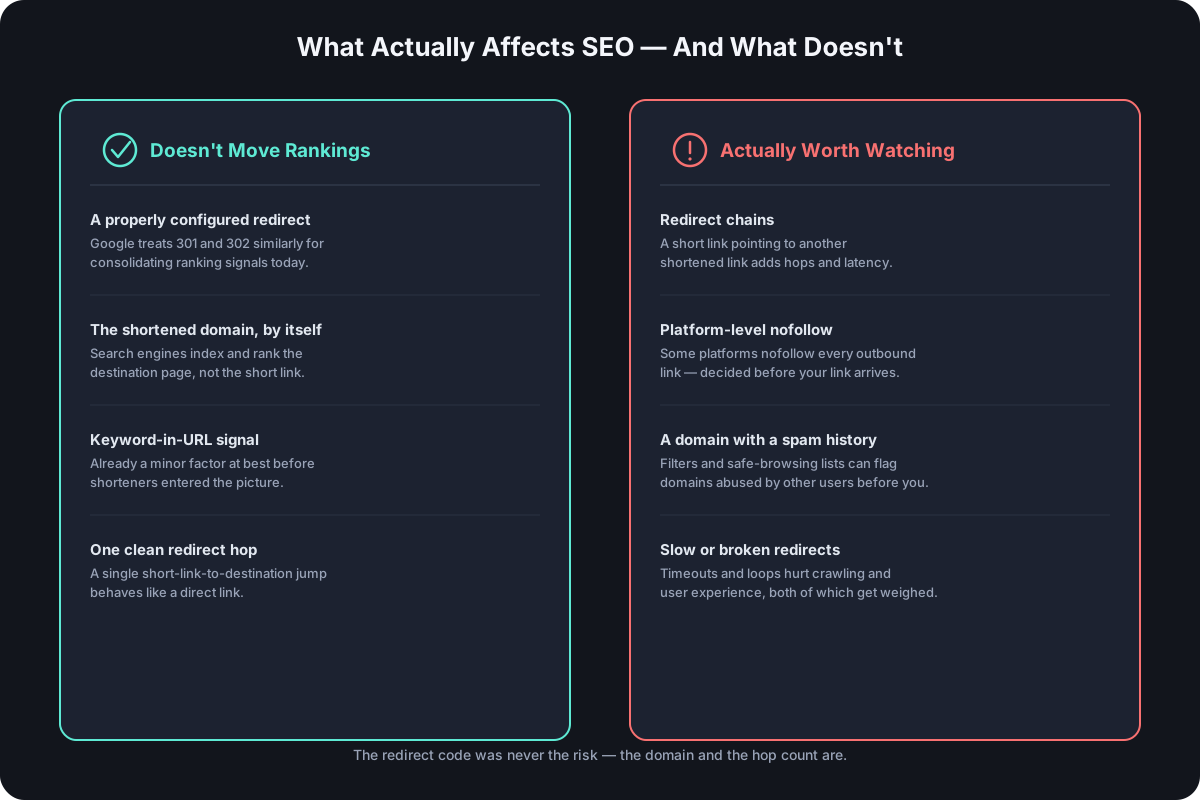
A search engine doesn't index the short link. It follows the redirect and indexes, ranks, and shows the destination page — the short link is a hop in between, not a page competing for a ranking spot of its own. That single fact resolves most of the anxiety behind the question: if a search engine ranks the destination, then the destination's content, backlinks, and technical health are what determine its ranking, not the fact that a visitor arrived there by way of cut.bd/launch instead of the raw URL.
The mechanics of that redirect matter for click analytics and for whether a browser can cache the wrong destination — but for ranking purposes specifically, Google has said publicly that it treats 301 and 302 redirects similarly when consolidating ranking signals in most cases today. The historical worry that a "temporary" 302 status code silently withholds ranking value from the destination isn't how it plays out in practice.
Where a Real SEO Risk Does Exist
None of that means shortened links are risk-free — it means the risk isn't where most people look for it. Four things are worth actually watching:
Redirect chains. One redirect — short link to destination — is a non-issue. A short link that redirects to another shortened link, which redirects again before finally landing, is a different situation. Multiple hops add latency, and search engines have documented crawl-budget and clarity reasons to prefer resolving to a destination in one jump rather than three. If you're shortening a link that's already been shortened once, you've created a chain without meaning to.
Platform-level nofollow. Some platforms attach a rel="nofollow" attribute to every outbound link regardless of what that link points to or how it's shortened — a platform decision made once at the infrastructure level, not something that changes based on which shortener you used. If a link is going out through a platform that nofollows everything, no shortener choice changes that; the nofollow was already decided before your link ever entered the picture.
A domain with a spam or abuse history. Shared public shorteners have historically been abused for phishing and spam at a higher rate than shorteners used by a single legitimate business, which means some spam filters and safe-browsing lists treat certain public shortener domains with more suspicion than a domain with no such history. This isn't really an "SEO" effect in the ranking-algorithm sense — it's more that a flagged domain can get blocked or warned against before a person even reaches the destination, which is a click and trust problem more than a rankings one, but it's real and worth knowing about.
Slow or broken redirects. A redirect that times out, loops, or takes several seconds to resolve creates a genuinely bad crawling and user experience, and both of those are things search engines do weigh, just not for the reason people usually assume ("temporary redirect = penalty"). A fast, single-hop redirect that reliably resolves is the actual technical bar to clear.
The Myth That Won't Die: Keywords in the URL
A lingering belief from an earlier era of SEO is that a URL slug packed with your target keyword — example.com/best-running-shoes-2026 instead of a shortened or generic link — carries meaningful ranking weight on its own. Google has said for years that exact keyword matches in a URL are, at most, a very minor signal, and shortening a URL doesn't remove content-level signals like on-page text, headings, or the backlink's own anchor text — it only changes what the URL string itself looks like. The keyword-in-URL effect was already small before shorteners entered the conversation; a short link isn't erasing a powerful signal, because the signal was never doing much work to begin with.
Where a Branded Domain Actually Changes the Calculus
This is the one place shortener choice genuinely matters, and it's not really an SEO argument — it's a trust argument that happens to touch SEO-adjacent territory. A link on your own branded domain reads as coming from you, carries your domain's existing reputation instead of a shared shortener's, and sidesteps the "is this a suspicious shortened link" hesitation some readers and spam filters both have toward generic shortener domains. It doesn't change how the destination page ranks, but it removes the one legitimate shortener-specific risk factor — an unfamiliar or reputation-diluted domain sitting in front of your content — entirely.
A Practical Checklist
If the SEO question is what's actually keeping you from using shortened links, here's what to check instead of worrying about the redirect code itself:
- Is it a single redirect hop, not a chain through another shortener?
- Does it resolve fast and reliably, without timeouts or loops?
- Is it on a domain — ideally your own — without a spam or abuse history?
- Are you still writing real anchor text and on-page content on the destination, rather than expecting the URL string to do that work?
Get those four right and the redirect layer stops being something to worry about at all.
Frequently Asked Questions
Does a shortened link pass less "link juice" than a direct link? Not meaningfully, for a properly configured single-hop redirect — Google has said it treats 301 and 302 similarly for consolidating ranking signals, and the destination page is what gets indexed and ranked either way.
Should I avoid shortened links in guest posts or backlinks specifically? The redirect type isn't the risk there; a chain of multiple redirects or a domain with a spam history is. A single-hop redirect through a reputable or branded domain behaves the same as a direct link for ranking purposes.
Does Google actually crawl through a shortener to find the destination? Yes — a crawler follows the HTTP redirect the same way a browser does, reaches the destination, and indexes that page's content.
Is a custom domain worth it just for SEO? Not purely for SEO — the ranking mechanics work the same on a generic shortener domain as a custom one — but it removes the one real shortener-specific trust risk (an unfamiliar domain) and is worth it for branding and click-through reasons regardless.
Has this changed over time? Yes — the "302 loses ranking value" concern is a holdover from an older, more conservative statement Google has since walked back for most cases. If you learned SEO more than a few years ago, this is one of the places that guidance has genuinely moved.
Where Cut.bd Fits
Cut.bd defaults every link to a single-hop 302 redirect — no chains, no stale cached destinations — and every plan supports a custom branded domain, which covers the one shortener-specific factor that's actually worth managing rather than the redirect-code myth that isn't.
Found this useful? Share it.
Try Cut.bd's link shortener — free, no account required.
Shorten a link