Common UTM Mistakes That Break Your Reports
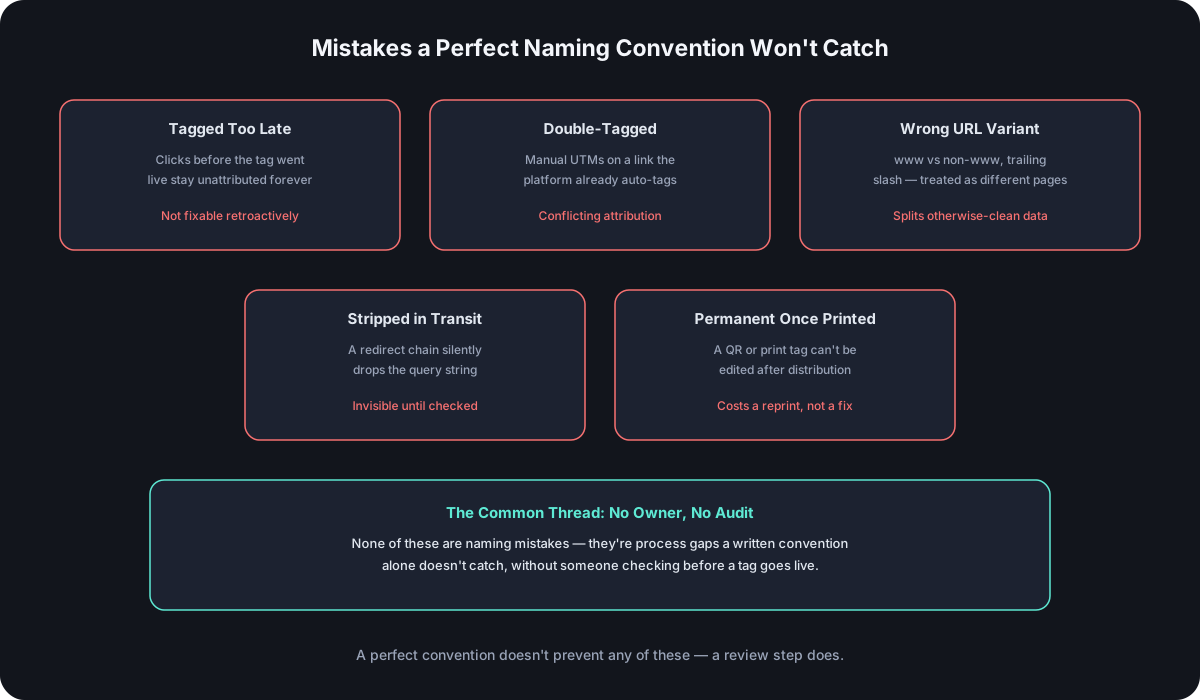
Most UTM troubleshooting content stops at casing and naming drift — real problems, already covered elsewhere in this series, but not the only way a UTM tagging program quietly breaks. A team with a perfect, consistently-applied naming convention can still lose real data to mistakes that have nothing to do with spelling: timing, platform conflicts, URL variants, and redirects that strip parameters nobody thought to test.
Tagging After the Campaign Already Launched
UTM data can't be applied retroactively — a click that already happened and wasn't tagged stays permanently unattributed, no matter how good the tagging is from that point forward. A campaign that runs untagged for its first week has a real, unfixable gap in whatever ROI calculation that data eventually feeds. The practical fix isn't a smarter tool, it's a checklist step: tagging happens before a link goes live, not as cleanup after someone notices the data looks thin.
Double-Tagging a Link a Platform Already Auto-Tags
Google Ads auto-tags its own clicks with a gclid parameter, and several other ad platforms do the equivalent with their own click identifiers. Adding manual UTM parameters on top of a platform's own auto-tagging doesn't just add redundant data — it can create conflicting attribution where the platform's own tracking and your manual tags disagree about the same click. The rule that actually holds: check whether the platform you're tagging for already has native tracking before manually adding UTMs, rather than assuming more tags are always safer.
Tagging the Wrong URL Variant
https://example.com/sale, https://www.example.com/sale, and https://example.com/sale/ can all resolve to the same page while registering as three different URLs to an analytics tool. A UTM tag is perfectly correct and still fragments your data if it's attached to a URL variant that doesn't match whatever canonical version the rest of your reporting uses — the tag isn't the problem, the destination underneath it is. Worth checking once, explicitly: which exact variant (protocol, www or not, trailing slash or not) is the one everything else in your reporting is built around, and tag against that one consistently.
Losing the Tag Through an Untested Redirect Chain
A UTM-tagged link that passes through more than one redirect — a shortened link pointing at another shortened link, or a CMS redirect rule between the two — can silently drop the query string at any hop, and not every redirect implementation preserves it by default. The failure is invisible until someone actually checks: the link still works, the visitor still lands on the right page, and only the attribution data goes missing. Test every redirect chain end to end at least once, checking the final URL's query string, rather than assuming a working redirect also means a working tag.
Treating a Printed or QR Tag Like a Digital One
A typo in a digital UTM link can be fixed the moment it's noticed — update the link, done. A UTM tag baked into a QR code on printed packaging or signage can't be corrected the same way once it's printed; the mistake lives for the entire physical run. This is the one category of UTM mistake worth a second reviewer specifically, since the cost of catching it before printing is trivial and the cost of catching it after is a full reprint, or worse, months of permanently mistagged scans.
No Owner Means No Audit
A written naming convention holds only as long as someone is actually checking new tags against it before they go live. Without a designated owner or even a lightweight review step, drift happens gradually and invisibly — not through any one person being careless, but through a slow accumulation of individually-reasonable-looking exceptions that nobody was positioned to catch. This is less a mistake in any single tag and more a structural gap in the process around tagging, worth planning for once a team grows past one person doing all the tagging themselves.
Frequently Asked Questions
Can a missing UTM tag be added retroactively to fix a data gap? No — the tag has to be present at the moment of the click to attribute that session; a tag added afterward only affects future clicks on that link, not the ones that already happened.
Is it ever correct to have both a platform's auto-tagging and manual UTM parameters on the same link? Rarely, and only when you've specifically verified the two won't conflict — the default assumption should be that a platform's native auto-tagging is sufficient on its own, and manual tags are for everywhere that auto-tagging doesn't reach.
How do I check whether a redirect is dropping UTM parameters? Click the tagged link yourself and inspect the final URL's query string after every redirect hop resolves — if the utm_* parameters are missing from the final destination, something in the chain stripped them.
Should every printed or QR-coded link go through an extra review step? Worth considering specifically because of the permanence — a review step that would be excessive for a digital link that's trivially fixable is proportionate for something that can't be corrected once it's physically distributed.
Where Cut.bd Fits
Cut.bd's redirect is a single 302 hop from the short link directly to the tagged destination — no intermediate redirect chain that could silently drop the query string between the click and the page your UTM parameters need to reach. That closes off one specific failure mode from this list entirely; the rest — tagging before launch, avoiding auto-tagging conflicts, checking URL variants, reviewing anything headed for print — are process discipline no tool can fully automate away.
Found this useful? Share it.
Try Cut.bd's link shortener — free, no account required.
Shorten a link