The History of URL Shorteners (From TinyURL to Today)
URL shorteners didn't start as a marketing or analytics category — they started as a fix for a genuinely mundane technical annoyance. The category only became what it is today after that original problem mostly stopped mattering, which is a more interesting path than most tools take.
The Original Problem: URLs That Broke When Wrapped
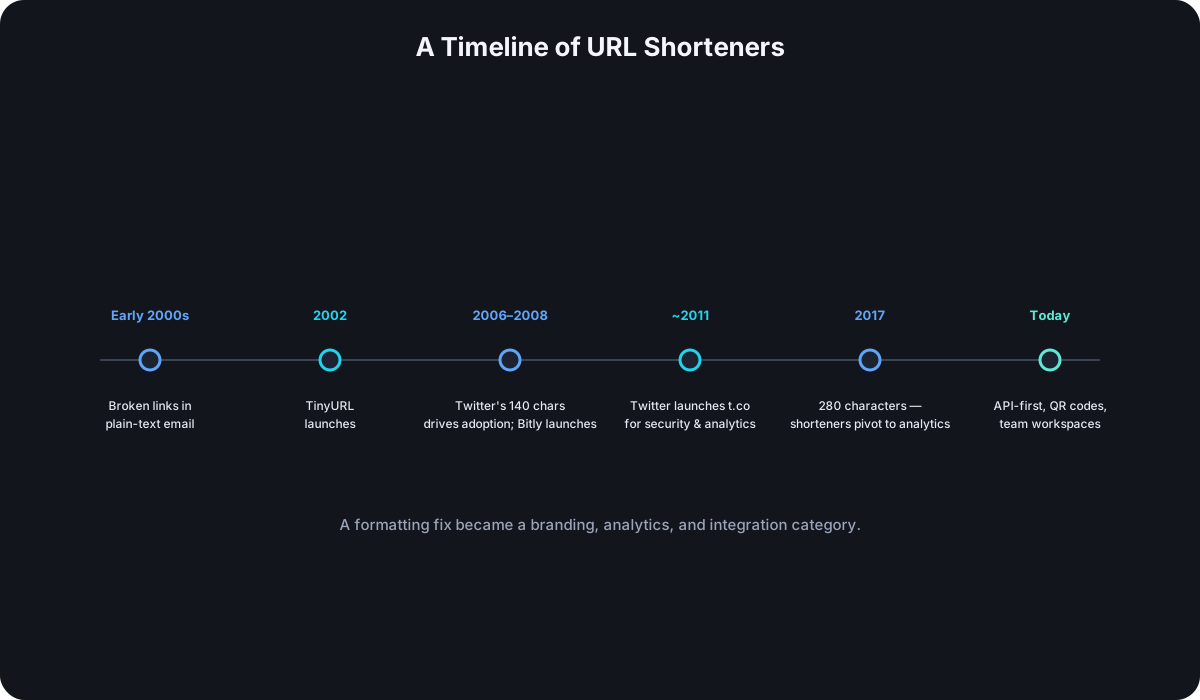
In the era of plain-text email and Usenet, a long URL — especially one with a query string full of parameters — would frequently wrap across two lines when displayed. A wrapped link often couldn't be clicked or reliably copy-pasted as one piece, breaking silently in a way that was hard to diagnose from the sender's side. The earliest URL shorteners existed to solve exactly that: turn an unreliable, multi-line link into one short, unbroken string that would survive being pasted anywhere.
Before dedicated shortening services existed, people worked around the problem manually — splitting a long URL across multiple lines with instructions to "remove the line break before pasting," or posting a link with a note asking the recipient to combine two fragments themselves. Neither was reliable, and both put the burden on the person receiving the link rather than the person sending it, which is the specific friction a dedicated shortening service removed entirely.
TinyURL and the First Wave
TinyURL, launched in 2002, is widely credited as the service that popularized the format — a simple redirect with no analytics, no branding, no dashboard, just a long URL going in and a short one coming out. That simplicity was the entire point: it solved the broken-link problem directly, with nothing else attached to justify the trade-off of routing your link through someone else's domain.
Twitter's Character Limit Changed the Incentives
Twitter's 2006 launch, and the 140-character limit that defined it for its first decade, turned URL shortening from a nice-to-have into something close to mandatory. A single unshortened link could consume a large share of a tweet's entire character budget, and shorteners — Bitly especially, launching in 2008 and quickly becoming closely associated with the platform — became standard infrastructure for sharing anything on Twitter at all. Twitter later built its own shortener, t.co, automatically wrapping every outgoing link by around 2011 — not primarily to save characters at that point, but for spam filtering and click-level analytics, a shift in purpose that mirrors what happened to the category more broadly.
From Character-Counting to Analytics and Branding
As platforms relaxed their constraints — Twitter itself expanded to 280 characters in 2017 — the original character-saving justification for URL shorteners weakened. The category didn't shrink with it; it repositioned around what a shortened link had been quietly capable of the whole time. Every redirect through a shortener is a loggable event — device, location, timing — which turned out to be worth more once click data became the point rather than a side effect of solving a formatting problem. Branded domains followed the same arc: what started as an option became a differentiator, and is trending toward an expectation.
QR Codes Bring Shorteners Into the Physical World
The more recent chapter connects short links to something offline entirely. A QR code is just a visual encoding of a URL — pairing one with a short link instead of a raw destination turns a scan on a poster, a product package, or a storefront window into the same kind of trackable, editable event a digital click always was, extending the category's core value proposition into physical media it was never originally built for.
Where Shorteners Are Today
The modern category looks less like a single utility and more like infrastructure: API-first integration for products that create links programmatically rather than through a dashboard, team and workspace features for organizations past a single owner, and self-hosted options for anyone who needs full control over the data. None of that was part of the original 2002-era pitch — it's what the category grew into once the character-counting problem it started with mostly disappeared.
Frequently Asked Questions
Was TinyURL the first URL shortener ever? It's the earliest widely credited with popularizing the format, though the general idea of a redirect service predates it in less prominent forms — TinyURL is the one that's stuck in the category's origin story.
Why did Twitter build its own shortener instead of using an existing one? Primarily for security screening and consistent click analytics across every link on the platform, not character savings — by the time t.co launched, controlling the redirect layer mattered more to Twitter than the character count did.
Do URL shorteners still matter now that most platforms don't have tight character limits? Yes, for different reasons than they started with — analytics, branding, and QR code integration are now the primary value, not character savings, which is exactly the shift this history traces.
Is the category still evolving, or has it settled into its current form? Still evolving — API-first tooling and team-scale features are recent, ongoing shifts, not a finished state, and the QR-code chapter is itself a relatively recent addition to what shorteners are used for.
What replaced character-counting as the main reason to use a shortener? Analytics and branding, in roughly that order historically — click tracking was the first thing shorteners had that a raw link didn't, and branded domains followed once businesses realized the shortener's own domain was showing up on every link they shared.
Where Cut.bd Fits
The features that matter most today — custom domains, click analytics, QR codes, and API access — are exactly what the category evolved toward after its original character-counting purpose faded, and they're built into Cut.bd from the Free plan rather than treated as an afterthought.
Found this useful? Share it.
Try Cut.bd's link shortener — free, no account required.
Shorten a link