URL Shortener Industry Trends: What's Actually Changing in 2026
Most "industry statistics" roundups in this category cite a growth percentage or market-size figure with no visible source behind it — a number that sounds authoritative and is almost never traceable to real research. This isn't that. What follows are the real, observable shifts shaping how URL shorteners get used in 2026, each explained through the reasoning behind it rather than a borrowed statistic.
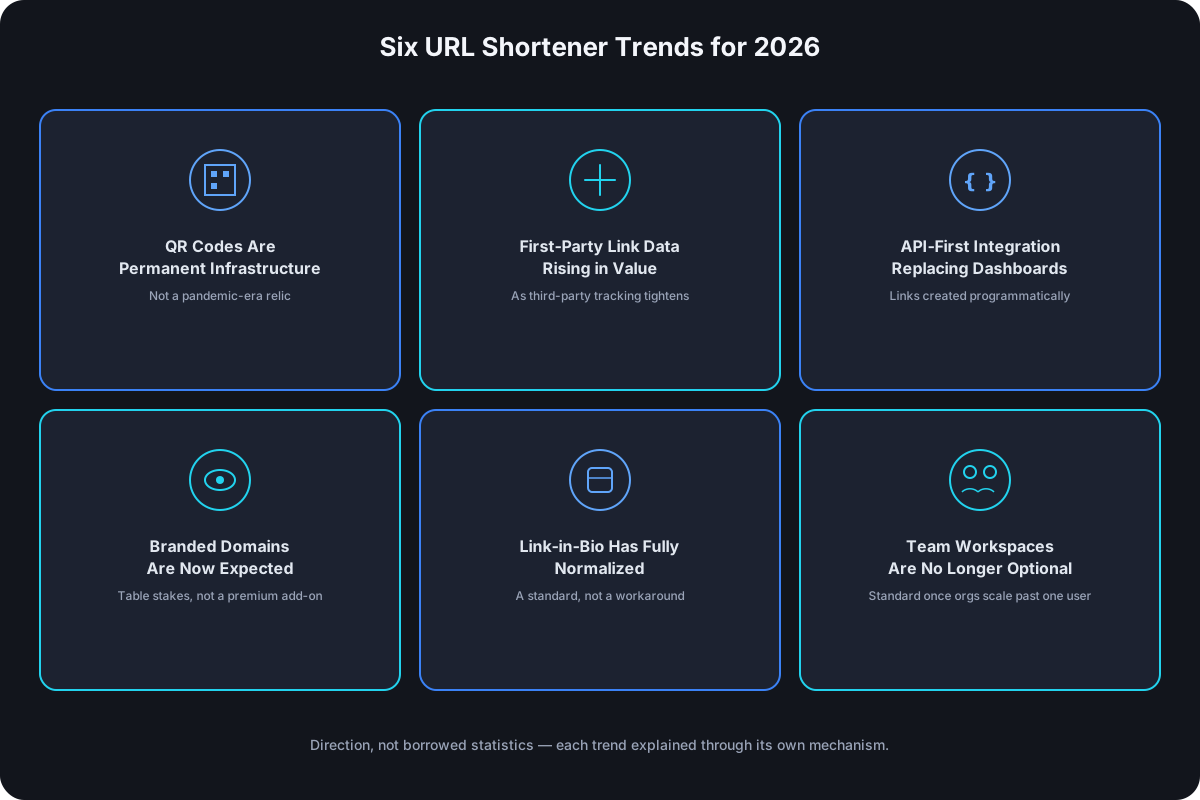
QR Codes Are Permanent Infrastructure Now
The pandemic-era spike in QR code adoption — contactless menus, packaging, storefront signage — didn't recede once the reason for it did. QR codes paired with short links stuck around because they solved a real, ongoing problem independent of the circumstances that first popularized them: a physical object needs a fast, camera-based path to a digital destination, and that need didn't go away. What's changed since is expectation — a QR code on packaging or a poster reads as normal now, not novel, which means the bar has shifted from "does this have a QR code" to "does the QR code actually track and lead somewhere worth going."
Third-Party Tracking Is Getting Harder, Which Makes First-Party Link Data More Valuable
Browser-level restrictions on third-party tracking have been tightening for years, and that trajectory hasn't reversed. Every restriction on cross-site tracking makes data collected directly through a first-party relationship — like a click on your own tagged short link — relatively more valuable, not less, because it isn't affected by the same restrictions. A shortener's click data was never third-party tracking to begin with: it's a direct record of someone clicking a link you created, which is exactly the kind of first-party signal that keeps working as the rest of the tracking landscape gets more restricted.
API-First Integration Is Replacing Manual Dashboard Use
The pattern across this entire content series has been consistent: building link creation into a product or workflow programmatically instead of a person manually shortening links one at a time in a dashboard. That shift tracks a broader one — as more of marketing and product work becomes automated end-to-end, a shortener that's only usable through a UI becomes a bottleneck, while one with a real API becomes infrastructure other tools build on top of.
Branded Domains Are Becoming Expected, Not Premium
The case for a branded domain hasn't changed, but the baseline expectation around it has shifted — a generic shortener domain on a business's public-facing links increasingly reads as an oversight rather than a neutral default, especially as more competitors in any given space have already made the switch. What used to be a differentiator is trending toward table stakes, the same way a branded email domain stopped being a luxury and became an assumption.
Link-in-Bio Has Fully Normalized as a Format
A single bio link expanding into a menu of destinations went from a workaround for Instagram's one-link constraint to a completely standard expectation — audiences now assume a bio link leads to a page with options, not a single destination. That normalization changes the calculus: it's no longer a question of whether to use the format, but whether the bio page and the tracked links behind it are actually connected to real analytics or just a static list of buttons.
Team and Workspace Features Are No Longer Optional at Scale
As marketing and growth functions grow past a single owner, tools built around one user managing everything hit a ceiling fast — shared link management, multi-seat access, and workspace-level separation for agencies managing multiple clients have moved from a nice-to-have to a baseline requirement for anything beyond a solo operator.
Why This Post Doesn't Cite Growth Percentages
Specific market-size and growth-rate figures for a category this narrow are rarely backed by rigorous, cited research — most numbers that circulate trace back to a single unverified source repeated without attribution, or to nothing at all. Citing one would have added a layer of false precision without adding real information. Everything above is a direction, not a number, because that's the honest level of confidence the underlying reasoning actually supports.
Frequently Asked Questions
Is the URL shortener market actually growing? Directionally, yes — the underlying use cases (social sharing, campaign tracking, QR-driven physical-to-digital links) have expanded rather than contracted, but a specific growth percentage isn't something this guide is willing to assert without a real source behind it.
Which of these trends matters most for a small business versus an enterprise? Branded domains and QR codes tend to matter earliest for smaller, consumer-facing operations; API integration and team/workspace features tend to matter once an organization has grown past a single person managing links by hand — the trends apply differently depending on where you sit on that curve.
Are these trends specific to URL shorteners, or part of something bigger? Mostly the latter — first-party data's rising value and API-first tooling are patterns playing out across marketing technology broadly, not unique to link shortening. URL shorteners are just one place those broader shifts show up concretely.
Will this post get updated as things change? The direction of each trend is unlikely to reverse quickly, but check the update date against how current the reasoning still feels — a post about "what's changing" is inherently more time-sensitive than one about fixed mechanics.
Where Cut.bd Fits
Every trend above maps to something covered in more depth elsewhere in this series — the complete guide to how URL shorteners work is the right starting point if you're new to the category, or the URL shortener API guide if the API-first shift above is the one that applies to what you're building.
Found this useful? Share it.
Try Cut.bd's link shortener — free, no account required.
Shorten a link